Sheets of Past and Peaks of Present: How the Order of Time Enters the Image
A version-based analysis of coexisting pasts, divergent presents, and the chronosign
Concept relation
- 01Several temporal versions appear→
- 02Each version receives a temporal position→
- 03Pasts coexist / presents become incompossible→
- 04Temporal relation directly links images
Sheets of past and peaks of present are parallel forms of the order of time. Sheets present the whole past as coexisting degrees of contraction; peaks present several de-actualized presents of one event as simultaneous and incompossible. Temporal relation thus replaces continuity of action as a principle of narration.
Cinema 2 chapter 5 establishes both temporal orders and directly analyzes Citizen Kane, Last Year at Marienbad, and Muriel. Kaili Blues is an atlas comparison.
Primary coordinates
DELEUZE PRIMARY TEXTsheets of the past
FACT → RELATION → TEST
The past as a structure of coexistence
Recollection is not stored content in a mind but selection and actualization from coexisting sheets of the pure past.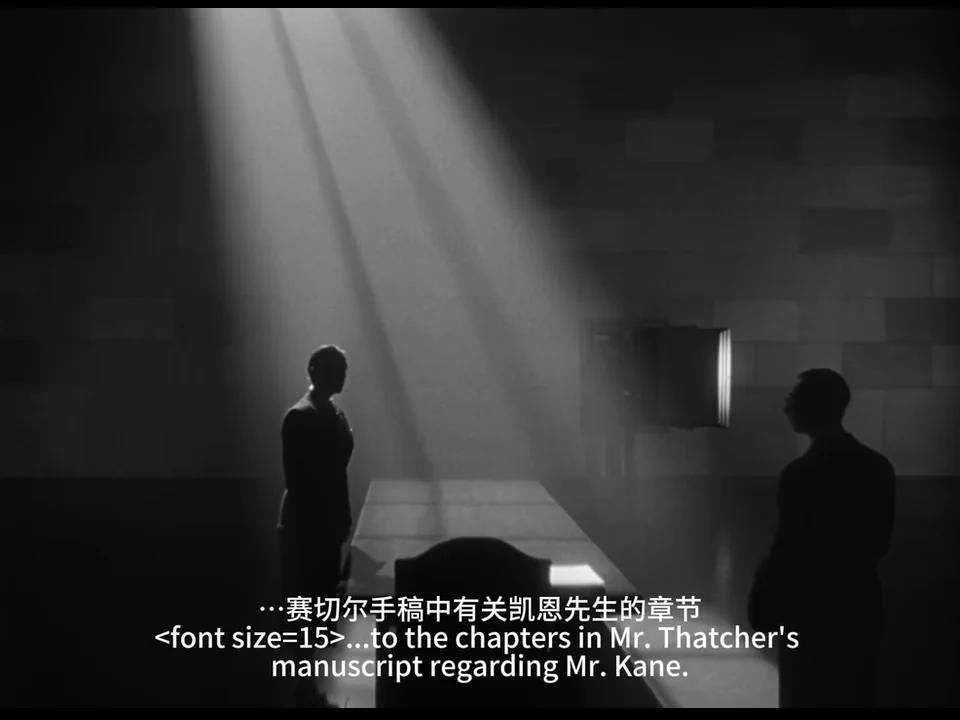 第3分段 00:00:15 / Part 3 00:00:15
The investigation does not return to one past; it enters one sheet through a witness document.
A single overhead beam cuts out the large reading table and manuscript while the figures recede into silhouettes.
The archive material lies between the two figures as a material entrance into Kane's past.
The attendant directs Thompson to the chapters of Thatcher's manuscript concerning Kane.
SITE ANALYSISThe manuscript is not a key that solves a life but one sheet opened by witness, document, and image; later testimonies enter other sheets.
Cinema 2, chapter 5, pp. 105, 110–111, 115–119.Bilibili at 第3分段 00:00:15 / Part 3 00:00:15 Open original still ↗Part 3 was frame-checked; the anchor is the entrance into Thatcher's manuscript.Complete Bilibili carrier; the shot at 第3分段 00:00:15 was checked frame by frame, and the still and timestamp come from the same public upload.
Bilibili · Citizen Kane, part 3 · verified 2026-08-14The whole past is preserved at once yet stratified by degrees of contraction, tone, theme, and points of brightness. Recollection does not retrieve fixed data from storage; it selects a sheet and actualizes recollection-images within it.[1, pp. 98–99, 105–110][2, pp. 152, 162, 168–169]
Citizen Kane lets each witness open another sheet of past. Every sheet provides real material, while none totalizes Kane; Rosebud cannot close the life into a single explanation. Depth of field performs a search, making the actual image a space of access to the virtual past.[1, pp. 105–113][3, pp. 79–120]
FACT → RELATION → TEST
The present as simultaneous divergence
Peaks of present allow several presents of one event to persist simultaneously; each works internally, while their conjunction is incompossible.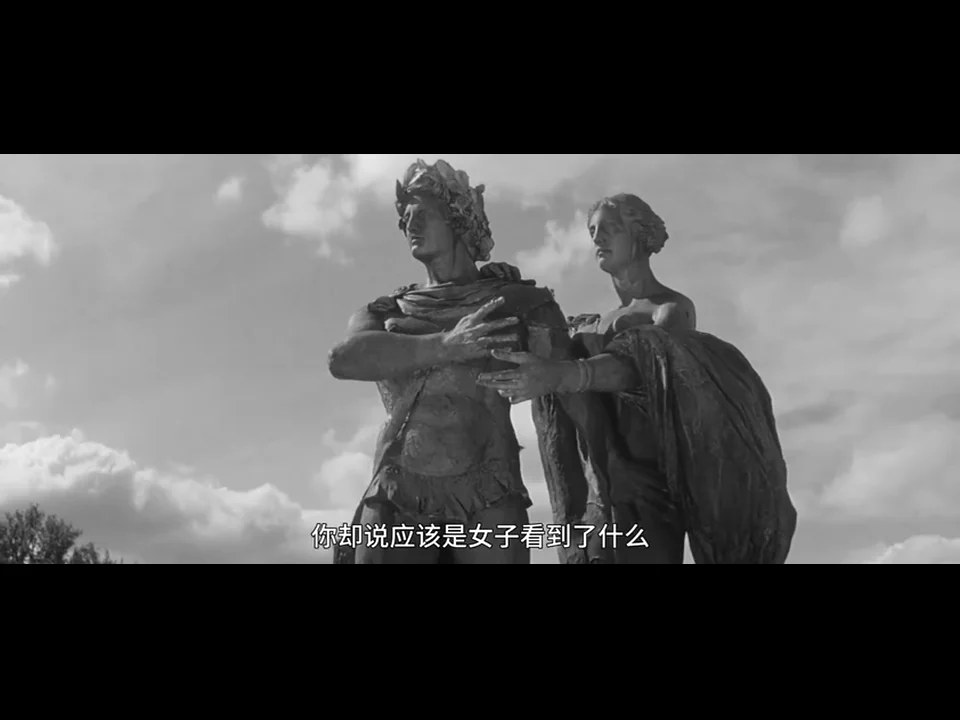 00:01:45
The same statues carry two accounts: he says the man stops the woman; she says the woman is the one who first sees something.
The image cuts from the woman in the garden to paired statues and then circles behind them.
At the anchor, the burned-in subtitle states that she had offered the reading in which the woman saw something.
A male voice first offers the reading that the man stops the woman, then recalls the other reading in which the woman sees something.
SITE ANALYSISThe film does not resolve the two readings into one recoverable past. The same visible object sustains two present versions, leaving the past in an incompossible relation to the present.
Cinema 2, chapter 5, English translation pp. 101, 106, 108; atlas shot analysis.Bilibili at 00:01:45 Open original still ↗Excerpt-upload timeline, frame-verified to within one second.A continuous 2:57 original-film excerpt, not the complete feature; film identity, continuity, burned-in subtitles, and anonymous playback were frame-verified.
Bilibili continuous original-film excerpt · moimoichou · verified 2026-08-14In Last Year at Marienbad, the encounter has already happened, has never happened, and is taking place for the first time. Repeated shots do not return to an original event; they distribute different presents across figures, speech, and space.[1, ch. 5, pp. 101, 103–105]
Rodowick treats this structure as time reorganizing narrative truth. Peaks are not successive hypotheses but simultaneous de-actualized presents; analysis must keep versions parallel rather than select a winner too early.[3, pp. 79–120]
FACT → RELATION → TEST
Temporal relation takes over image linkage
A chronosign appears when coexistence of sheets or simultaneity of peaks directly organizes shots.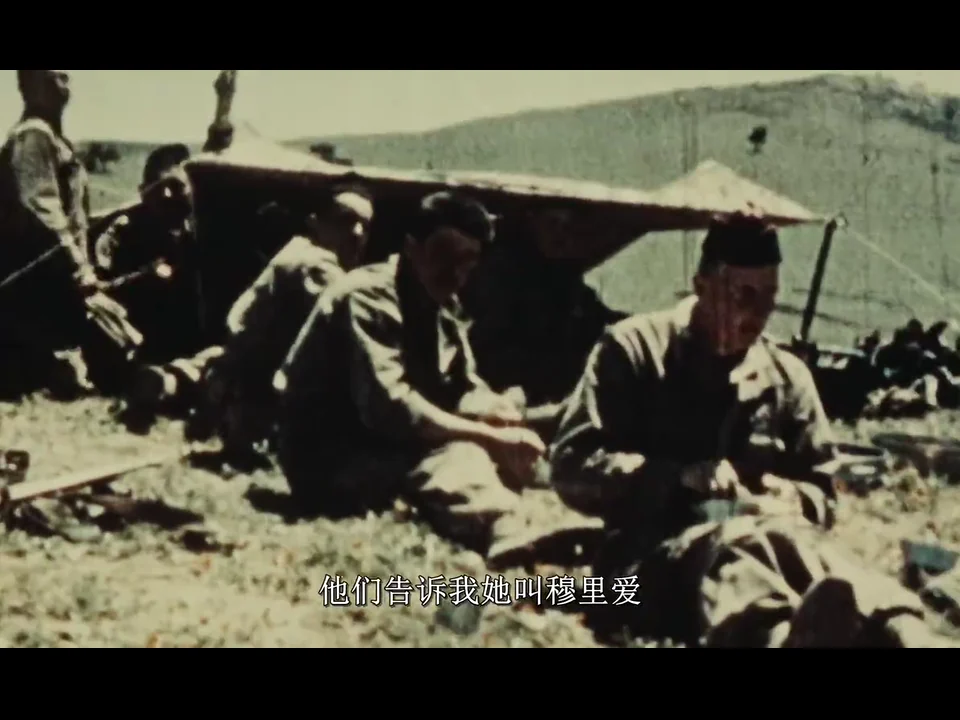 第11分段 00:00:25 / Part 11 00:00:25
The routine soldiers' footage does not show torture; Bernard's present voice presses the absent event into the image.
The 8mm footage shows soldiers sitting and resting in the hills; it does not show the torture Bernard describes.
Grain, faded colour, and projected-film texture mark the footage as another layer of record.
Over 8mm images without synchronized location sound, Bernard's present voice names Muriel and continues his account.
SITE ANALYSISThe wartime past is neither fully restored by the footage nor contained in speech; the split between routine images and torture testimony makes the past act in the present as an untotalizable sheet.
Cinema 2, chapter 5, pp. 116, 118, 120, 122–123; these are film-level primary-text coordinates, while the present shot relation is this site's analysis.Bilibili at 第11分段 00:00:25 / Part 11 00:00:25 Open original still ↗Part 11 was frame-checked; the anchor lies in the disjunction between silent 8mm footage and Bernard's narration.Complete Bilibili carrier; the shot at 第11分段 00:00:25 was checked frame by frame, and the still and timestamp come from the same public upload.
Bilibili · Muriel, part 11 · verified 2026-08-1400:01:45The same statues carry two accounts: he says the man stops the woman; she says the woman is the one who first sees something.
The image cuts from the woman in the garden to paired statues and then circles behind them.
At the anchor, the burned-in subtitle states that she had offered the reading in which the woman saw something.
A male voice first offers the reading that the man stops the woman, then recalls the other reading in which the woman sees something.
SITE ANALYSISThe film does not resolve the two readings into one recoverable past. The same visible object sustains two present versions, leaving the past in an incompossible relation to the present.
Cinema 2, chapter 5, English translation pp. 101, 106, 108; atlas shot analysis.Bilibili at 00:01:45 Open original still ↗Excerpt-upload timeline, frame-verified to within one second.A continuous 2:57 original-film excerpt, not the complete feature; film identity, continuity, burned-in subtitles, and anonymous playback were frame-verified.
Bilibili continuous original-film excerpt · moimoichou · verified 2026-08-14The page cover, tag, and comments form a strong lead toward Kaili Blues, but its title is only ‘Feature’ and the single part runs 4:50:33, far beyond common editions. The atlas preserves this concrete gateway; until page contents, feature boundaries, and Dangmai timecode are checked separately, it is not promoted to still-backed shot evidence. The previously checked BV1ef4y1x7d1 remains present-day location footage used only as comparison, not as an original-film passage.
Open logged gateway page or search record checked 2026-08-25Muriel moves the Algerian War past across rooms, furniture, broken speech, and abrupt montage. The characters cannot restore the fragments to a stable chronology; distribution of the past organizes the image before action can explain it.[1, ch. 5, pp. 116, 118, 120, 122–123][4, pp. 151–156]
The Dangmai long take in Kaili Blues contracts search, former relations, future premonitions, and spatial traversal into one present. Marking how past and future anchors modify current action tests whether the passage forms sheets, peaks, or a transition between the two orders.[4, pp. 151–156]
FACT → RELATION → TEST
Can database operations reorder the visible past?
The atlas proposes a hypothesis that still requires version-bound evidence: retrieval, refresh, and predictive interfaces may reorder how recorded material enters a present decision. An actual database is not the virtual past, and content juxtaposition is not a peak of present. The bridge gains evidence only when a versioned operation changes an actual relation among body, memory, or choice.The page cover, tag, and comments form a strong lead toward Kaili Blues, but its title is only ‘Feature’ and the single part runs 4:50:33, far beyond common editions. The atlas preserves this concrete gateway; until page contents, feature boundaries, and Dangmai timecode are checked separately, it is not promoted to still-backed shot evidence. The previously checked BV1ef4y1x7d1 remains present-day location footage used only as comparison, not as an original-film passage.
Open logged gateway page or search record checked 2026-08-25Rodowick reads sheets of past and peaks of present through Deleuze's ontology of time, while Pisters studies brain-screens, digital culture, and networked feedback. Neither proves that an actual database ‘translates’ sheets or peaks into ranking and prediction. Connecting the two is an atlas bridge: record the interface, data version, and feedback consequence, then test whether the operation changes the order in which a past becomes visible to a present choice.[3, ‘Time and Memory: Orders and Powers,’ pp. 79–120][5, Chapters on brain-screen and database time]
The long walk in Kaili Blues folds town, memory, and future clues into one route; Long Day's Journey into Night splits the same night into incompatible presents through cinema, dream, and replay. Both films serve as pre-digital tests for the interface age: identify which sheet is recalled first, then ask whether replay changes the present's capacity to act.
Film comparisons
Citizen Kane
Witnesses enter different sheetsEach witness supplies evidence from one sheet of the past, but no sheet exhausts Kane's life.
Deleuze discusses this film directly here · pp. 105–113第3分段 00:00:15 / Part 3 00:00:15The investigation does not return to one past; it enters one sheet through a witness document.
A single overhead beam cuts out the large reading table and manuscript while the figures recede into silhouettes.
The archive material lies between the two figures as a material entrance into Kane's past.
The attendant directs Thompson to the chapters of Thatcher's manuscript concerning Kane.
SITE ANALYSISThe manuscript is not a key that solves a life but one sheet opened by witness, document, and image; later testimonies enter other sheets.
Cinema 2, chapter 5, pp. 105, 110–111, 115–119.Bilibili at 第3分段 00:00:15 / Part 3 00:00:15 Open original still ↗Part 3 was frame-checked; the anchor is the entrance into Thatcher's manuscript.Complete Bilibili carrier; the shot at 第3分段 00:00:15 was checked frame by frame, and the still and timestamp come from the same public upload.
Bilibili · Citizen Kane, part 3 · verified 2026-08-14Last Year at Marienbad
Several presents of one encounterThe same encounter appears as already happened, never happened, and happening for the first time, producing incompossible presents.
Deleuze discusses this film directly here · ch. 5, pp. 101, 103–10500:01:45The same statues carry two accounts: he says the man stops the woman; she says the woman is the one who first sees something.
The image cuts from the woman in the garden to paired statues and then circles behind them.
At the anchor, the burned-in subtitle states that she had offered the reading in which the woman saw something.
A male voice first offers the reading that the man stops the woman, then recalls the other reading in which the woman sees something.
SITE ANALYSISThe film does not resolve the two readings into one recoverable past. The same visible object sustains two present versions, leaving the past in an incompossible relation to the present.
Cinema 2, chapter 5, English translation pp. 101, 106, 108; atlas shot analysis.Bilibili at 00:01:45 Open original still ↗Excerpt-upload timeline, frame-verified to within one second.A continuous 2:57 original-film excerpt, not the complete feature; film identity, continuity, burned-in subtitles, and anonymous playback were frame-verified.
Bilibili continuous original-film excerpt · moimoichou · verified 2026-08-14Muriel
Stratigraphic historical memoryA wartime past moves within the present through space, objects, speech, and montage.
Deleuze discusses this film directly here · ch. 5, pp. 116, 118, 120, 122–123第11分段 00:00:25 / Part 11 00:00:25The routine soldiers' footage does not show torture; Bernard's present voice presses the absent event into the image.
The 8mm footage shows soldiers sitting and resting in the hills; it does not show the torture Bernard describes.
Grain, faded colour, and projected-film texture mark the footage as another layer of record.
Over 8mm images without synchronized location sound, Bernard's present voice names Muriel and continues his account.
SITE ANALYSISThe wartime past is neither fully restored by the footage nor contained in speech; the split between routine images and torture testimony makes the past act in the present as an untotalizable sheet.
Cinema 2, chapter 5, pp. 116, 118, 120, 122–123; these are film-level primary-text coordinates, while the present shot relation is this site's analysis.Bilibili at 第11分段 00:00:25 / Part 11 00:00:25 Open original still ↗Part 11 was frame-checked; the anchor lies in the disjunction between silent 8mm footage and Bernard's narration.Complete Bilibili carrier; the shot at 第11分段 00:00:25 was checked frame by frame, and the still and timestamp come from the same public upload.
Bilibili · Muriel, part 11 · verified 2026-08-14Kaili Blues
Temporal anchors in a long takeTests both orders by tracing how past and future alter present action.
The page cover, tag, and comments form a strong lead toward Kaili Blues, but its title is only ‘Feature’ and the single part runs 4:50:33, far beyond common editions. The atlas preserves this concrete gateway; until page contents, feature boundaries, and Dangmai timecode are checked separately, it is not promoted to still-backed shot evidence. The previously checked BV1ef4y1x7d1 remains present-day location footage used only as comparison, not as an original-film passage.
Open logged gateway page or search record checked 2026-08-25Put the claim back into more films
These films are not a list of examples but pressure tests: when the same concept meets different spaces, bodies, sounds, and narrations, which relations still hold and which must be withdrawn?
How does the past coexist and the present fork?
Place testimony, catastrophe, machine, and fragments on one replay line: sheets ask which past is being searched, while peaks ask which presents persist together.
Last Year at Marienbad
One encounter forks into sheets of past and peaks of present
The same encounter can be said to have happened, never to have happened, or to be happening for the first time. The film's bifocal structure preserves the past as coexisting sheets while letting incompatible presents persist; no single recollection line unifies time.
00:01:45- CONCEPT MOVE
- Resnais's sheets and Robbe-Grillet's peaks remain distinct within one work and press upon one another.
- SHOT EVIDENCE
- Mark the narrator, space, bodily attitude, and consequence for each version; compare which objects remain fixed and which relations are rewritten.
- BOUNDARY
- Narrative ambiguity is not automatically a structure of time; identify how incompatible presents or coexisting pasts change the viewing position.
Cinema 2, ch. 5, pp. 101, 103–105
LOCATORGarden, corridor, and the three versions of the encounter
Citizen Kane
Each witness enters a different sheet of Kane's past
The reporter and witnesses search Kane from different angles. Each sheet supplies real material, yet none can totalize a life. The final word does not close the sheets into psychological causality; it leaves a past unavailable to every character.
第3分段 00:00:15 / Part 3 00:00:15- CONCEPT MOVE
- Memory is not a storehouse but multiple realities entered from different positions of testimony.
- SHOT EVIDENCE
- Place each witness's account beside framing, depth of field, and archival material; record where its sheet cannot merge with another.
- BOUNDARY
- Revealing one word is not the same as finding a complete cause; if it merely explains motivation, the openness of the sheets has been erased.
Cinema 2, ch. 5, pp. 105–113
LOCATORSwitches among witness recollection and archive sheets
How scholarship advances the problem
D. N. Rodowick
Gilles Deleuze's Time MachinePlaces memory, temporal orders, and truth within the full architecture of the cinema philosophy.
Used to show how temporal relation takes over narrative linkage.Open full citation ↓David Deamer
Deleuze's Cinema BooksProvides a taxonomy of chronosigns and a film-by-film analytical method.
Used to turn version, position, evidence, and consequence into an operational table.Open full citation ↓Patricia Pisters
The Neuro-ImageProvides a framework for brain-screens, digital culture, and networked feedback, but does not directly prove that a database equals the virtual past or translates temporal sheets into retrieval and prediction.
The atlas bridge uses it to formulate a version-dependent hypothesis of database time, tested through interface, feedback, and consequences for action.Open full citation ↓References
- 01
DELEUZE PRIMARY TEXT Gilles Deleuze, Cinema 2: The Time-Image, trans. Hugh Tomlinson and Robert Galeta (University of Minnesota Press, 1989).
Chapter 5, pp. 98–125Publisher record and purchase access - 02
PRIMARY PHILOSOPHICAL SOURCE Henri Bergson, Matter and Memory, trans. Nancy Margaret Paul and W. Scott Palmer (Zone Books, 1991).
Chapter 3, pp. 133–177; memory cone at pp. 152, 162Publisher record and purchase access - 03
SCHOLARSHIP D. N. Rodowick, Gilles Deleuze's Time Machine (Duke University Press, 1997).
“Time and Memory: Orders and Powers,” pp. 79–120DOI record and purchase access · DOI 10.1215/9780822396871 - 04
SCHOLARSHIP David Deamer, Deleuze's Cinema Books: Three Introductions to the Taxonomy of Images (Edinburgh University Press, 2016).
“Chronosigns,” pp. 151–156Publisher record and purchase access - 05
SCHOLARSHIP Patricia Pisters, The Neuro-Image: A Deleuzian Film-Philosophy of Digital Screen Culture (Stanford University Press, 2012).
Chapters on brain-screen, database narration, and neuropoliticsPublisher record and preview