The Crystal-Image: How Actual and Virtual Exchange
Identifying the actual–virtual relation through the smallest circuit, the split of time, and crystalline states
Concept relation
- 01An actual image appears→
- 02Its contemporaneous virtual side arises→
- 03The two remain distinct and exchange positions→
- 04The split of time becomes visible
The crystal-image contracts an actual image and its contemporaneous virtual image into the smallest circuit. The two remain different in kind yet lose fixed assignability through exchange, making the passing present and the preserved past visible together.
Cinema 2 chapter 4 directly analyzes The Lady from Shanghai, Lola Montès, and Mirror. Comparisons with Mulholland Drive and the Pompeii scene are atlas analyses.
Primary coordinates
DELEUZE PRIMARY TEXTthe smallest internal circuit
FACT → RELATION → TEST
The smallest circuit preserves difference and removes fixed assignability
The crystal requires both actual–virtual difference in kind and unassignability within the circuit.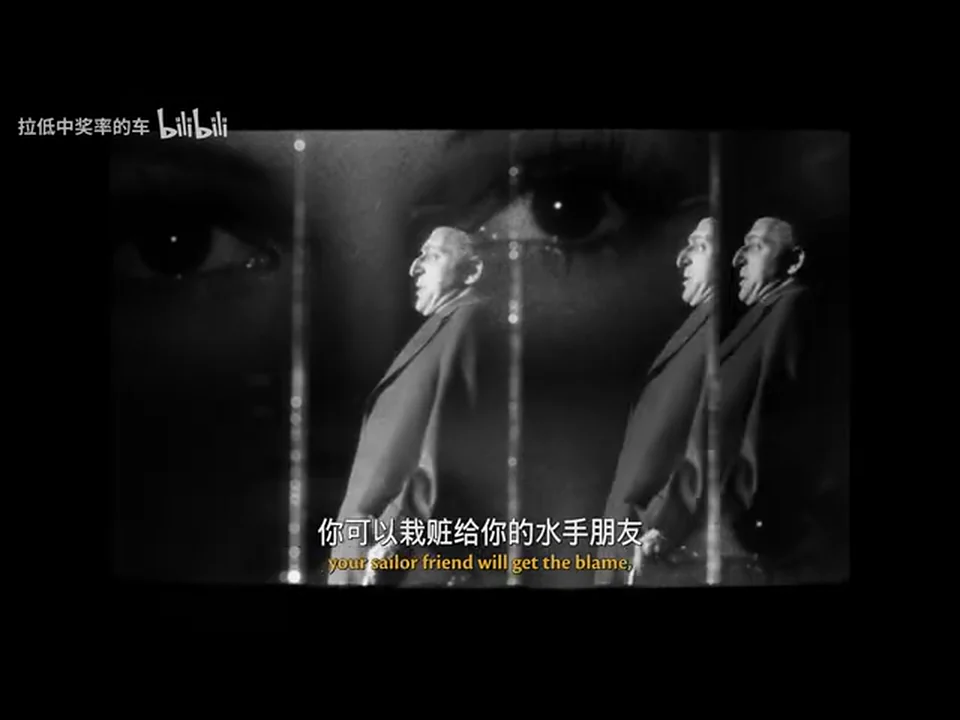 01:23:40
One speaker becomes body, reflection, and watched double at the same time.
Three profiles of Bannister stand side by side while mirror seams split them apart.
Enlarged eyes in the background share a plane with the foreground reflections, removing any stable position of vision.
Bannister continues shifting blame toward O'Hara; one voice corresponds to several visible bodies.
SITE ANALYSISActual body and virtual reflections remain distinguishable while continually exchanging within the hall; the later shattering is not decoration but the termination of this crystal circuit.
Cinema 2, chapter 4, pp. 68–87.Bilibili at 01:23:40 Open original still ↗The mirror-hall passage was frame-checked; the anchor precedes the gunfire that terminates the proliferating reflections.Complete Bilibili carrier; the shot at 单片 01:23:40 was checked frame by frame, and the still and timestamp come from the same public upload.
Bilibili · The Lady from Shanghai complete film · verified 2026-08-14The hall of mirrors in The Lady from Shanghai multiplies bodies, reflections, doubles, and deception in one field. A character's actuality is absorbed by mirror images, while reflections acquire visible actuality; neither side permanently owns the actual position.[1, p. 70][4, pp. 119–133]
When gunfire shatters the mirrors, exchange stops with the proliferating circuit and bodies become locatable again. The mirrors perform and terminate a circuit; if they merely duplicate space, create symmetry, or symbolize narcissism, the crystalline test is not met.[1, p. 70]
FACT → RELATION → TEST
The crystal shows time splitting at every instant
The present must pass while becoming present and preserve itself as past.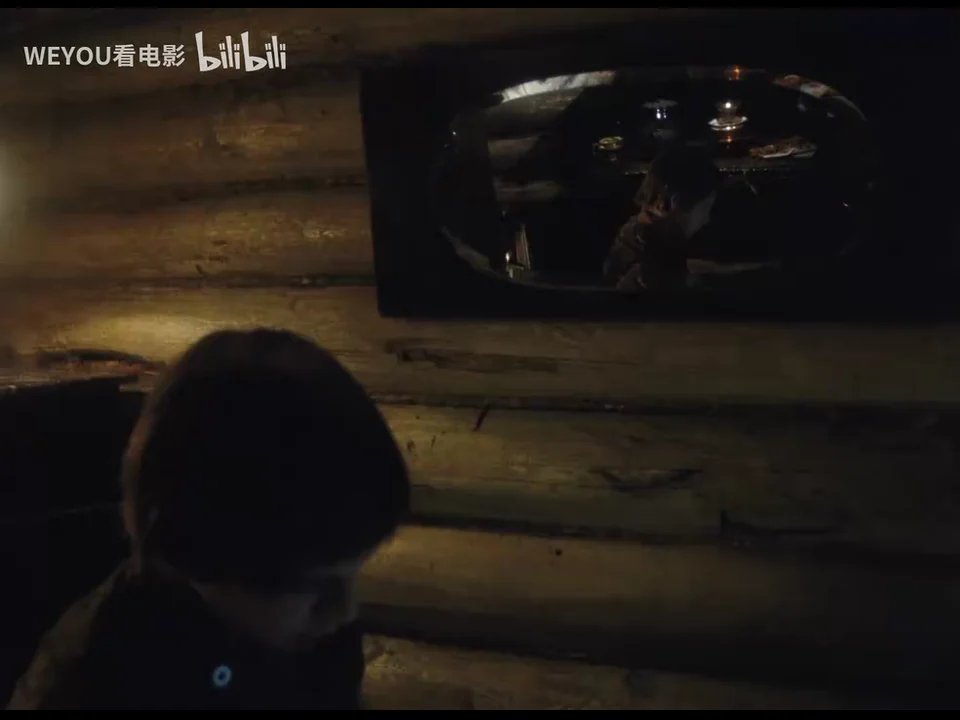 01:25:00
The boy outside the mirror and the reflected figures share one composition without reducing to one viewing position.
The boy's head remains below and outside the mirror; the oval glass inserts another group into the same timber-wall composition.
The bright mirror interior and darker exterior remain visible together without a cut to a separate memory shot.
Inside and outside the mirror share one continuous interior sound field; the reflected image receives no separate source of sound.
SITE ANALYSISThis mirror shot establishes only two visible zones within one composition; it does not by itself prove actual–virtual exchange. A crystalline reading still requires the returns of mother/wife, shifts between childhood and adulthood, and the archival passages.
Cinema 2, chapter 4, pp. 68–87.Bilibili at 01:25:00 Open original still ↗Frame-checked within the interior mirror passage.Complete Bilibili carrier; the shot at 单片 01:25:00 was checked frame by frame, and the still and timestamp come from the same public upload.
Bilibili · Mirror complete film · verified 2026-08-14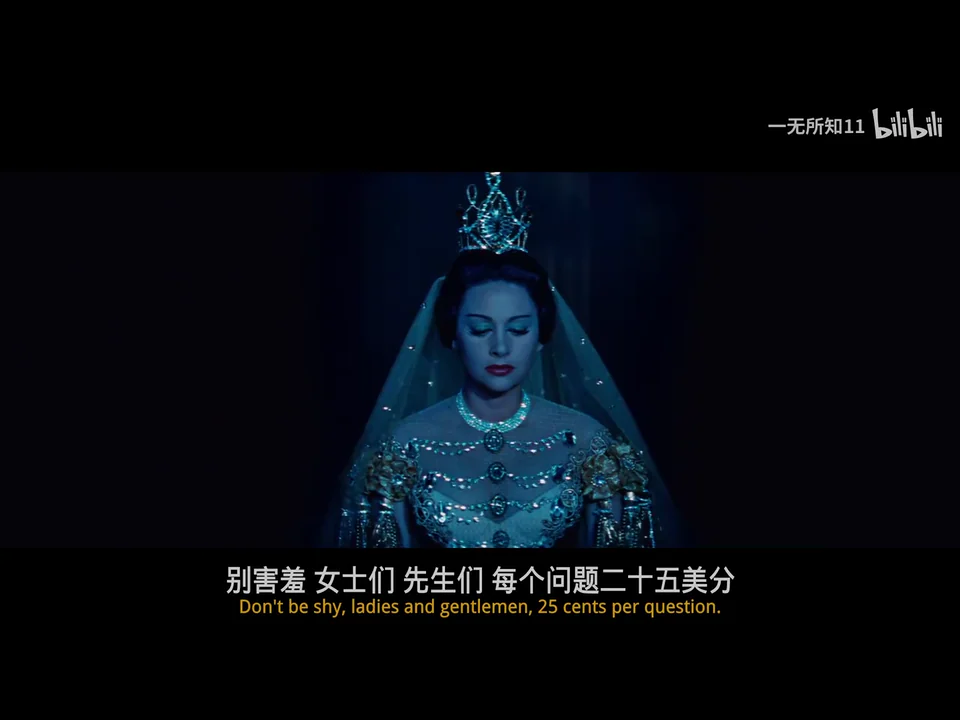 00:07:00
Her life is enclosed in the circus present as a repeatable, chargeable public exhibit.
Lola remains frontally still in an isolated pool of light while the surrounding stage falls into darkness.
Crown, jewels, and centred framing turn the person into an exhibited image.
The ringmaster directly solicits audience questions and announces a charge of twenty-five cents for each one.
SITE ANALYSISThe circus present repeatedly recalls and prices Lola's past, making actual performance and virtual life feed one another in a closed circuit.
Cinema 2, chapter 4, pp. 68–87.Bilibili at 00:07:00 Open original still ↗Frame-checked within the paid-question passage of the circus opening.Complete Bilibili carrier; the shot at 单片 00:07:00 was checked frame by frame, and the still and timestamp come from the same public upload.
Bilibili · Lola Montès complete film · verified 2026-08-14Mirror draws mother and wife, childhood and adulthood, perception and memory into a turning circuit; Deleuze calls it a turning crystal. Every present carries a contemporaneous virtual past rather than producing the past only after disappearing.[1, p. 75][3, pp. 70–73]
Lola Montès contracts the circus present and a life restaged for display into a closed circuit. The figure is both actual and performing her exhibited role in the same present, so preservation of the past and passage of the present occupy one crystalline milieu.[1, pp. 83–84]
FACT → RELATION → TEST
Crystalline states determine how the circuit continues
Shattering, enclosure, turning, and decomposition are formal states of the circuit that determine temporal direction, not mood labels.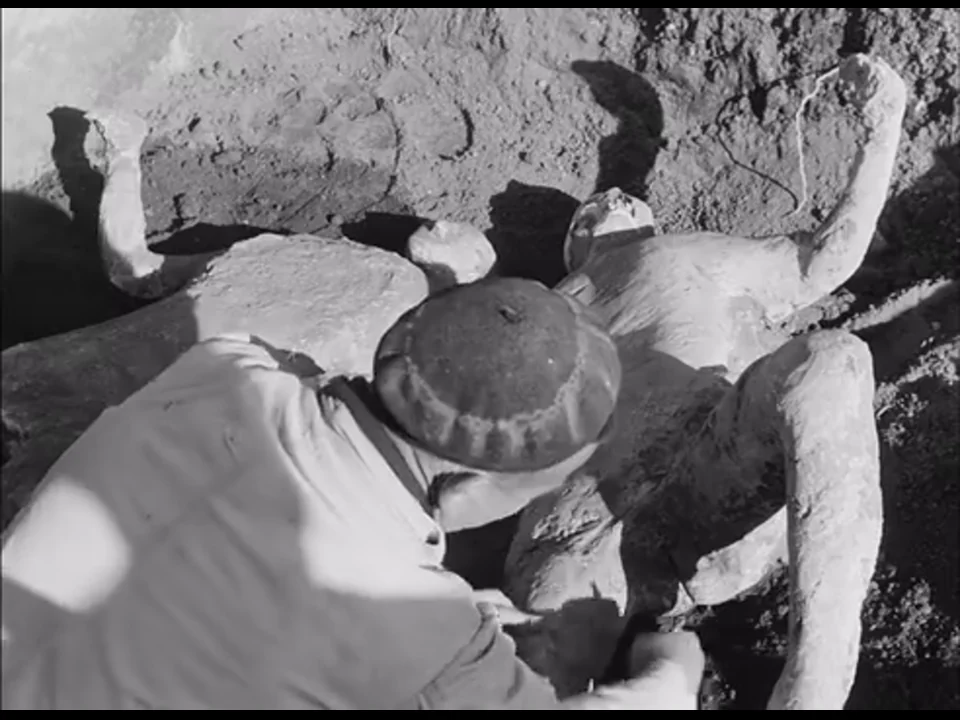
The technical operation successfully restores bodily contours while depriving the watching couple of their capacity to keep bearing the sight. Bilibili timecode 01:15:10.
Bilibili at 01:15:10 Open scene evidence01:23:40One speaker becomes body, reflection, and watched double at the same time.
Three profiles of Bannister stand side by side while mirror seams split them apart.
Enlarged eyes in the background share a plane with the foreground reflections, removing any stable position of vision.
Bannister continues shifting blame toward O'Hara; one voice corresponds to several visible bodies.
SITE ANALYSISActual body and virtual reflections remain distinguishable while continually exchanging within the hall; the later shattering is not decoration but the termination of this crystal circuit.
Cinema 2, chapter 4, pp. 68–87.Bilibili at 01:23:40 Open original still ↗The mirror-hall passage was frame-checked; the anchor precedes the gunfire that terminates the proliferating reflections.Complete Bilibili carrier; the shot at 单片 01:23:40 was checked frame by frame, and the still and timestamp come from the same public upload.
Bilibili · The Lady from Shanghai complete film · verified 2026-08-1400:07:00Her life is enclosed in the circus present as a repeatable, chargeable public exhibit.
Lola remains frontally still in an isolated pool of light while the surrounding stage falls into darkness.
Crown, jewels, and centred framing turn the person into an exhibited image.
The ringmaster directly solicits audience questions and announces a charge of twenty-five cents for each one.
SITE ANALYSISThe circus present repeatedly recalls and prices Lola's past, making actual performance and virtual life feed one another in a closed circuit.
Cinema 2, chapter 4, pp. 68–87.Bilibili at 00:07:00 Open original still ↗Frame-checked within the paid-question passage of the circus opening.Complete Bilibili carrier; the shot at 单片 00:07:00 was checked frame by frame, and the still and timestamp come from the same public upload.
Bilibili · Lola Montès complete film · verified 2026-08-1401:25:00The boy outside the mirror and the reflected figures share one composition without reducing to one viewing position.
The boy's head remains below and outside the mirror; the oval glass inserts another group into the same timber-wall composition.
The bright mirror interior and darker exterior remain visible together without a cut to a separate memory shot.
Inside and outside the mirror share one continuous interior sound field; the reflected image receives no separate source of sound.
SITE ANALYSISThis mirror shot establishes only two visible zones within one composition; it does not by itself prove actual–virtual exchange. A crystalline reading still requires the returns of mother/wife, shifts between childhood and adulthood, and the archival passages.
Cinema 2, chapter 4, pp. 68–87.Bilibili at 01:25:00 Open original still ↗Frame-checked within the interior mirror passage.Complete Bilibili carrier; the shot at 单片 01:25:00 was checked frame by frame, and the still and timestamp come from the same public upload.
Bilibili · Mirror complete film · verified 2026-08-14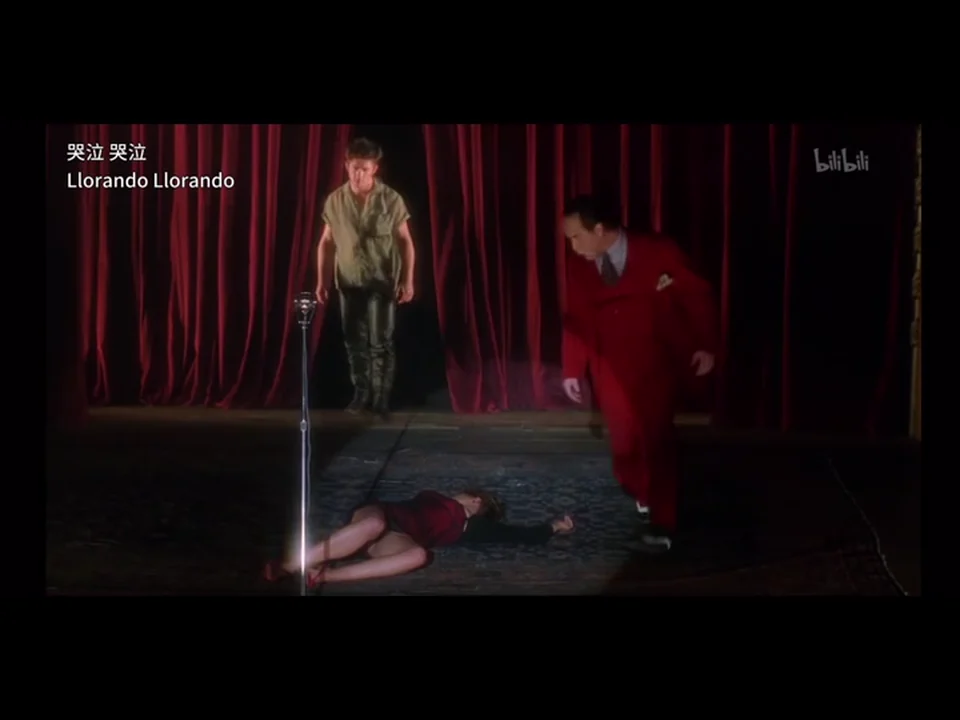 00:07:07
After the singer collapses, Llorando does not stop. The visible body loses its claim as source and the recording takes over the event.
The singer collapses beside the microphone; stagehands enter and carry her away while curtain and microphone remain.
Betty and Rita cry in the audience as the image alternates between stage and spectators.
The Spanish vocal continues for roughly twenty seconds after the singer collapses and is carried away, without breaking with her bodily action.
SITE ANALYSISLive performance and prerecorded voice first appear as one event; the collapse separates them. Their exchange removes the visible body's monopoly on reality and resets the evidentiary rules for the later identity shift.
Cinema 2, chapters 4 and 6; atlas shot analysis of the Club Silencio passage.Bilibili at 00:07:07 Open original still ↗Excerpt-upload timeline, frame- and audio-verified to within one second.A continuous 7:58 Club Silencio excerpt, not the complete feature; film identity, continuity, and anonymous playback were frame-verified. Bilibili submission label: repost.
Bilibili continuous original-film excerpt · MC天轩 · verified 2026-08-14Mulholland Drive can be tested through the shot-chain in which Betty/Diane, audition/performance, and wish/memory rewrite one another. The blue box, mirrors, or dream motif cannot decide the relation alone; the circuit and its turns must be mapped.
The Pompeii passage contracts an archaeological present and a past death into one sequence, yet the layers remain assignable: workers belong to the current operation and casts to the revealed past. It is a boundary case showing that temporal compression is not actual–virtual exchange.[3, pp. 68–76]
FACT → RELATION → TEST
The neuro-image: how the crystalline circuit connects to the brain-screen
The neuro-image carries the actual–virtual problem into networks, interfaces, and prediction systems, but it does not make every digital image crystalline; a distributed circuit must rewrite a body, memory, or choice in return.Pisters describes the neuro-image as a post-time-image formation in which brain, database, network, and surveillance turn images into computable yet forkable relations. Unlike the crystal-image's smallest two-sided circuit, the emphasis shifts to multi-node feedback; the researcher must specify which interface actualizes a virtual memory again.[5, Introduction and chapters on brain-screen and database narration]
The warehouse, copied city, and repeatedly replaced actors in Synecdoche, New York can be tested as a neuro-image field: the model does not reflect reality but rehearses its next version. Enter the Void links subjective camera, neon afterimages, and a post-mortem floating viewpoint into a brain-screen path. In both cases, ask whether the circuit changes an actual choice rather than merely producing sensory dizziness.
Film comparisons
The Lady from Shanghai
Shattered crystalThe hall multiplies actual and virtual; shattered mirrors terminate the circuit.
Deleuze discusses this film directly here · p. 7001:23:40One speaker becomes body, reflection, and watched double at the same time.
Three profiles of Bannister stand side by side while mirror seams split them apart.
Enlarged eyes in the background share a plane with the foreground reflections, removing any stable position of vision.
Bannister continues shifting blame toward O'Hara; one voice corresponds to several visible bodies.
SITE ANALYSISActual body and virtual reflections remain distinguishable while continually exchanging within the hall; the later shattering is not decoration but the termination of this crystal circuit.
Cinema 2, chapter 4, pp. 68–87.Bilibili at 01:23:40 Open original still ↗The mirror-hall passage was frame-checked; the anchor precedes the gunfire that terminates the proliferating reflections.Complete Bilibili carrier; the shot at 单片 01:23:40 was checked frame by frame, and the still and timestamp come from the same public upload.
Bilibili · The Lady from Shanghai complete film · verified 2026-08-14Lola Montès
Perfect crystalThe circus present encloses and restages a life as a circuit of display.
Deleuze discusses this film directly here · pp. 83–8400:07:00Her life is enclosed in the circus present as a repeatable, chargeable public exhibit.
Lola remains frontally still in an isolated pool of light while the surrounding stage falls into darkness.
Crown, jewels, and centred framing turn the person into an exhibited image.
The ringmaster directly solicits audience questions and announces a charge of twenty-five cents for each one.
SITE ANALYSISThe circus present repeatedly recalls and prices Lola's past, making actual performance and virtual life feed one another in a closed circuit.
Cinema 2, chapter 4, pp. 68–87.Bilibili at 00:07:00 Open original still ↗Frame-checked within the paid-question passage of the circus opening.Complete Bilibili carrier; the shot at 单片 00:07:00 was checked frame by frame, and the still and timestamp come from the same public upload.
Bilibili · Lola Montès complete film · verified 2026-08-14Mirror
Turning crystalFigures, ages, and memory positions exchange as the crystal turns from within.
Deleuze discusses this film directly here · p. 7501:25:00The boy outside the mirror and the reflected figures share one composition without reducing to one viewing position.
The boy's head remains below and outside the mirror; the oval glass inserts another group into the same timber-wall composition.
The bright mirror interior and darker exterior remain visible together without a cut to a separate memory shot.
Inside and outside the mirror share one continuous interior sound field; the reflected image receives no separate source of sound.
SITE ANALYSISThis mirror shot establishes only two visible zones within one composition; it does not by itself prove actual–virtual exchange. A crystalline reading still requires the returns of mother/wife, shifts between childhood and adulthood, and the archival passages.
Cinema 2, chapter 4, pp. 68–87.Bilibili at 01:25:00 Open original still ↗Frame-checked within the interior mirror passage.Complete Bilibili carrier; the shot at 单片 01:25:00 was checked frame by frame, and the still and timestamp come from the same public upload.
Bilibili · Mirror complete film · verified 2026-08-14Mulholland Drive
Identity-circuit testReciprocal rewriting of figure, performance, and memory tests a contemporary crystal.
00:07:07After the singer collapses, Llorando does not stop. The visible body loses its claim as source and the recording takes over the event.
The singer collapses beside the microphone; stagehands enter and carry her away while curtain and microphone remain.
Betty and Rita cry in the audience as the image alternates between stage and spectators.
The Spanish vocal continues for roughly twenty seconds after the singer collapses and is carried away, without breaking with her bodily action.
SITE ANALYSISLive performance and prerecorded voice first appear as one event; the collapse separates them. Their exchange removes the visible body's monopoly on reality and resets the evidentiary rules for the later identity shift.
Cinema 2, chapters 4 and 6; atlas shot analysis of the Club Silencio passage.Bilibili at 00:07:07 Open original still ↗Excerpt-upload timeline, frame- and audio-verified to within one second.A continuous 7:58 Club Silencio excerpt, not the complete feature; film identity, continuity, and anonymous playback were frame-verified. Bilibili submission label: repost.
Bilibili continuous original-film excerpt · MC天轩 · verified 2026-08-14Put the claim back into more films
These films are not a list of examples but pressure tests: when the same concept meets different spaces, bodies, sounds, and narrations, which relations still hold and which must be withdrawn?
How do actual and virtual rewrite one another?
Hall of mirrors, memory, rehearsal, and the memory-body offer different crystal configurations; the criterion remains reciprocal exchange, not mirror, flashback, or dream by itself.
The Lady from Shanghai
The hall of mirrors compresses actual bodies and virtual doubles into one circuit
Bodies, reflections, doubles, deception, and targets multiply in the hall of mirrors, leaving no privileged real body. When gunfire shatters the glass, both the circuit of exchange and its termination become visible.
01:23:40- CONCEPT MOVE
- Actual and virtual remain distinct while exchanging positions among mirror and target.
- SHOT EVIDENCE
- Mark each body, reflection, and line of fire; identify the moment when the target can no longer be stabilized as one body.
- BOUNDARY
- The mirror is a material, not the criterion; ordinary reflection without reciprocal exchange is only visual repetition.
Cinema 2, ch. 4, p. 70
LOCATORHall-of-mirrors finale; Cinema 2, ch. 4, p. 70
Mirror
Memory and perception exchange positions in a turning crystal
Mother and wife, childhood and present, memory and perception are drawn into one image environment. Deleuze directly calls Mirror a turning crystal: each face can become the actual or virtual side of another.
01:25:00- CONCEPT MOVE
- The past is not explained by recollection; it acquires a visible body within present perception.
- SHOT EVIDENCE
- Compare the mother/wife played by one actor with recurring rain, fire, wind, and water: which face is looking, and which is being looked at?
- BOUNDARY
- Autobiography or dream does not automatically form a crystal; actual and virtual must change one another within the image.
Cinema 2, ch. 4, p. 75
LOCATORAlternating mother/wife and elemental passages
How scholarship advances the problem
Paola Marrati
Gilles Deleuze: Cinema and PhilosophyPlaces the crystal within Deleuze's ontology of time and explains how it displays temporal splitting.
Used to distinguish the crystalline relation from psychological memory.Open full citation ↓Ronald Bogue
Deleuze on CinemaSystematizes the hyalosign, crystalline states, and their director-specific cases.
Used to build a two-stage analysis of minimal circuit and change of state.Open full citation ↓Patricia Pisters
The Neuro-ImageExtends the crystal problem to brain-screen, network, and neuropolitics as a post-time-image research position.
Used to distinguish the crystal's smallest circuit from the neuro-image's multi-node feedback.Open full citation ↓References
- 01
DELEUZE PRIMARY TEXT Gilles Deleuze, Cinema 2: The Time-Image, trans. Hugh Tomlinson and Robert Galeta (University of Minnesota Press, 1989).
Chapter 4, pp. 68–87Publisher record and purchase access - 02
DELEUZE PRIMARY TEXT Gilles Deleuze, Cinema 3 seminar, Lecture 18 (15 May 1984) and Lecture 19 (22 May 1984), Purdue archive.
Lecture 18 English transcript, pp. 3–5; Lecture 19, pp. 12–13Open audio and transcripts - 03
SCHOLARSHIP Paola Marrati, Gilles Deleuze: Cinema and Philosophy (Johns Hopkins University Press, 2008).
Chapter 5, “The Time-Image,” pp. 68–76Publisher record and purchase access · DOI 10.56021/9780801888021 - 04
SCHOLARSHIP Ronald Bogue, Deleuze on Cinema (Routledge, 2003).
Chapter 4, “Hyalosigns / Crystalline States,” pp. 119–133Publisher record and preview - 05
SCHOLARSHIP Patricia Pisters, The Neuro-Image: A Deleuzian Film-Philosophy of Digital Screen Culture (Stanford University Press, 2012).
Introduction and chapters on brain-screen and database narrationPublisher record and preview