Fabulation: How the Speech Act Prefigures a People to Come
Tracing an unfinished collective through double becoming, material consequences, and collective enunciation
Concept relation
- 01Characters tell and reenact their situation→
- 02Character and filmmaker change one another's position→
- 03Speech alters roles, resources, and labour→
- 04Collective enunciation prefigures a people to come
Fabulation produces reality through storytelling. Character and filmmaker become intercessors; private experience enters politics; speech changes roles, labour, resources, and authority. These visible effects produce collective enunciation and prefigure a plural, unfinished people to come.
Cinema 2 chapters 6 and 8 directly discuss Pour la suite du monde, Moi, un noir, and Black God, White Devil. Scene timecodes, visible facts, and consequences of speech come from this atlas's shot analysis; The Hour of the Furnaces compares another starting point for political cinema.
Primary coordinates
DELEUZE PRIMARY TEXTC’est l’appel à son peuple.
FACT → RELATION → TEST
Fabulation is a double becoming
Real characters become other through storytelling, while their intervention changes the filmmaker's position.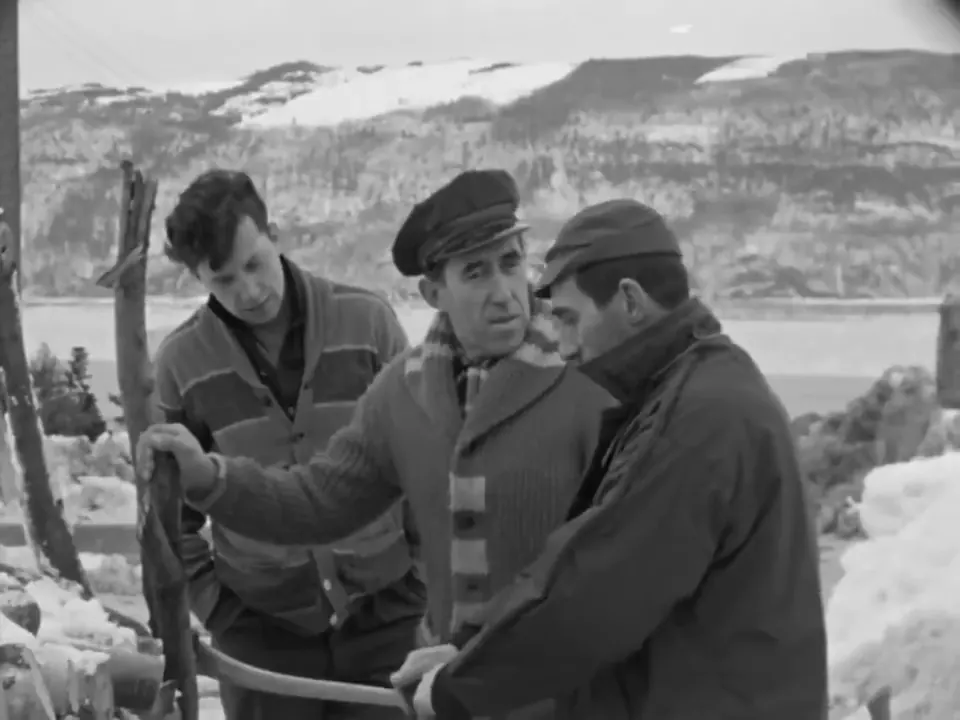
Preparations for the beluga hunt begin with a riverside discussion.
Bilibili at 00:10:00 Open scene evidenceThe query “我是黑人 让鲁什 1958” was run once (general ranking, all time, page 1) and returned neither Moi, un noir nor a verifiable key excerpt. Chronicle of a Summer and videos about Jean Rouch are different works and were not substituted.
page or search record checked 2026-08-14In Moi, un noir, assumed names, postsynchronized voices, and urban experience rewrite one another. Characters no longer supply material for a prior ethnography; through narration they perform and produce new subject positions, changing Rouch's authorial position through free indirect discourse.[1, pp. 151, 223][3, pp. 135–164]
The first discussions in Pour la suite du monde transform a long-interrupted beluga hunt from elders' memory into a shared object. Perrault proposes the revival, while islanders provide knowledge, disagreement, and labour; neither side alone determines what the film will produce.[1, ch. 6, p. 150; ch. 8, pp. 221, 223][4, pp. 202–226]
FACT → RELATION → TEST
The speech act is evidenced by real consequences
An utterance acquires efficacy when it changes participants, resources, tasks, labour, or authority within the film.Preparations for the beluga hunt begin with a riverside discussion.
Bilibili at 00:10:00 Open scene evidence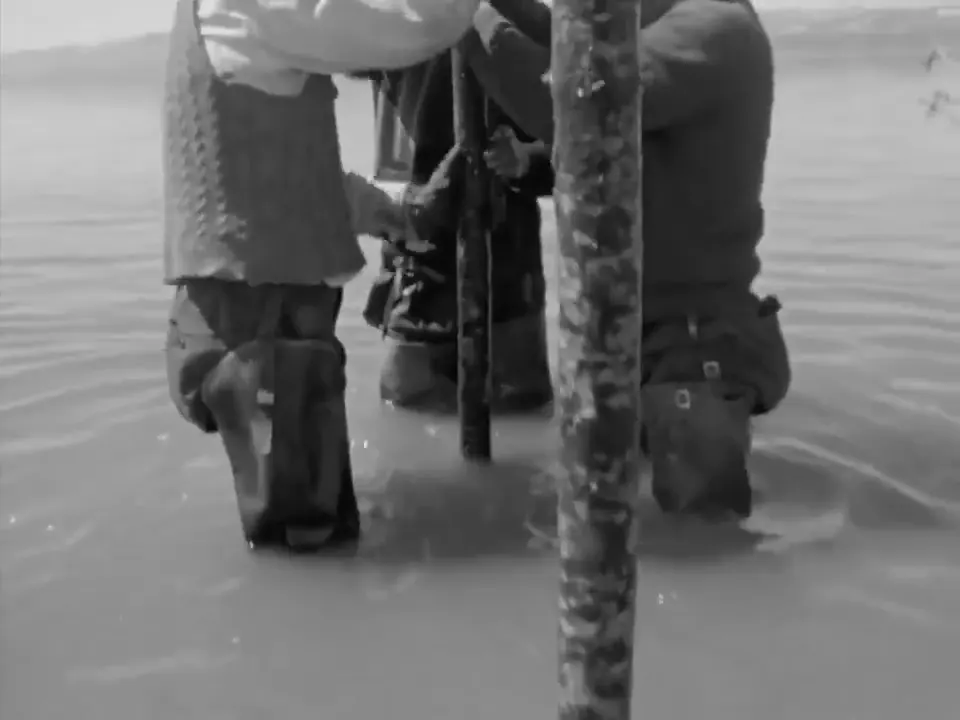
Deliberation, roles, and materials become shared construction in the water.
Bilibili at 00:43:56 Open scene evidence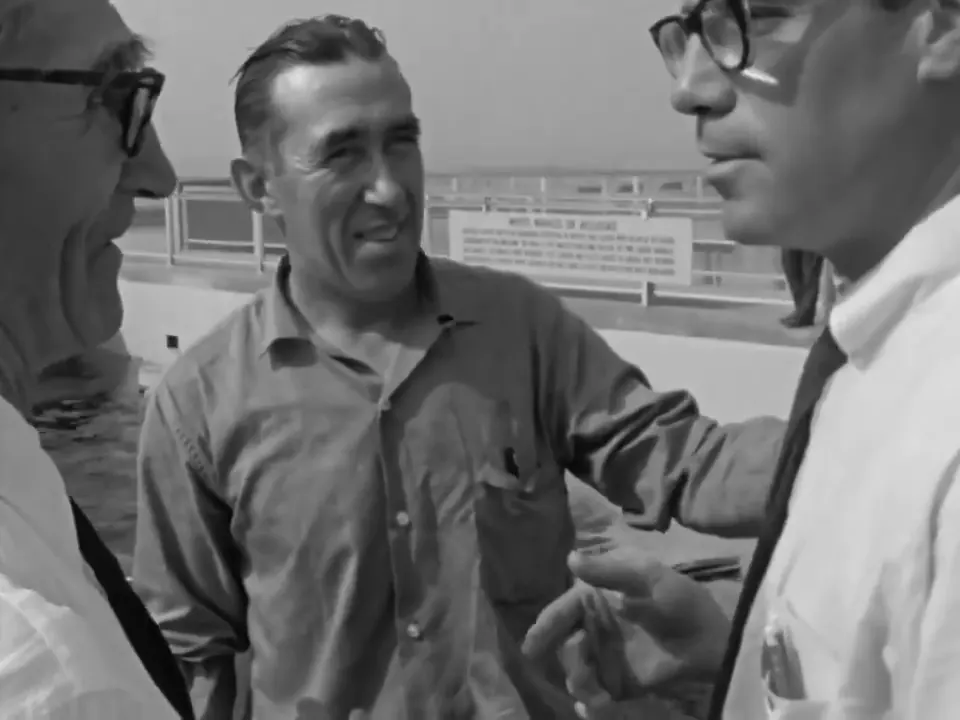
The group delegates one member to speak for them inside an institutional setting.
Bilibili at 01:40:00 Open scene evidenceElders speak knowledge of tides, posts, and beluga; islanders form a plan through discussion, obtain equipment through financing, and set posts in the tide. Speaker, addressee, circulation, and collective labour occupy one timeline, so speech enters a material assemblage.[1, ch. 6, p. 150; ch. 8, pp. 221, 223][4, pp. 202–226]
At the aquarium, the group explicitly delegates one person to speak on its behalf. An individual voice acquires a plural source and public capacity; authority is not conferred by voice-over but produced by a traceable act within the group.[1, ch. 6, p. 150; ch. 8, pp. 221, 223]
FACT → RELATION → TEST
Collective enunciation prefigures a people to come
A plural speaking position forms through disagreement, relay, response, and delegation; the people remains minor, unfinished, and future-facing.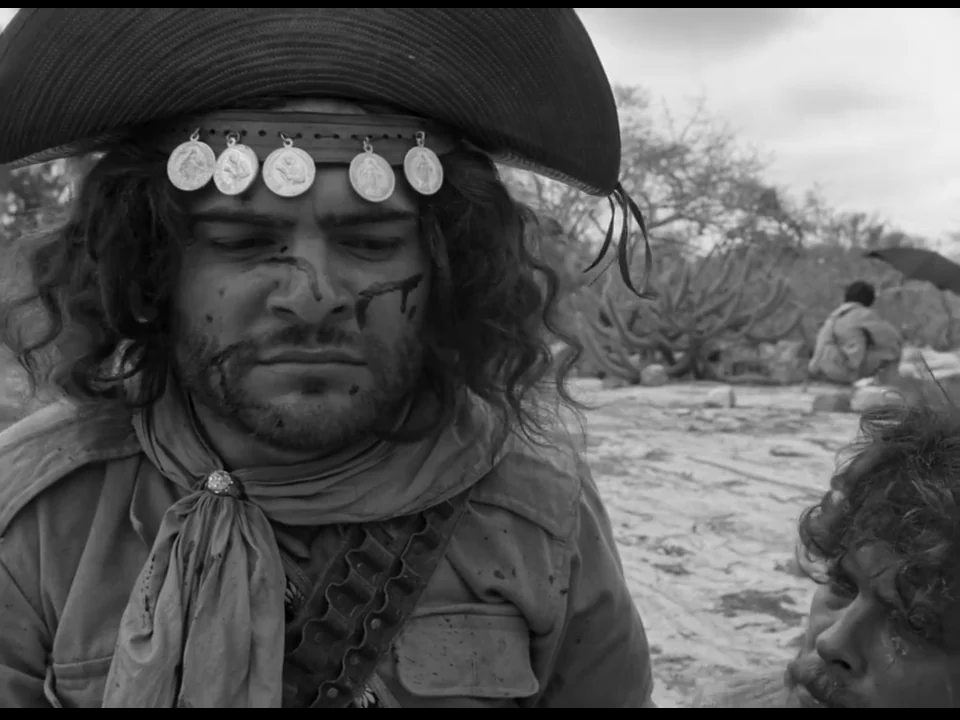 01:30:00
Bandit, mythical figure, and speaker are compressed into one face while allegiance remains in motion through speech.
Corisco's coin-hung hat, facial streaks, and frontal close-up bind costume, body, and mythical identity.
Manuel enters only from the lower edge, so their positions are not stabilized by balanced shot/reverse-shot.
Corisco challenges Manuel in loud, rhythmic speech closer to public performance than private conversation.
SITE ANALYSISFigures change allegiance among peasant, believer, bandit, and myth; the collective is not pre-completed, and Corisco's performative speech turns that absence into a condition of creation.
Cinema 2, chapter 8, pp. 222–223.Bilibili at 01:30:00 Open original still ↗The verbal challenge between Corisco and Manuel was frame-checked.Complete Bilibili carrier; the shot at 单片 01:30:00 was checked frame by frame, and the still and timestamp come from the same public upload.
Bilibili · Black God, White Devil complete film · verified 2026-08-14The query “我是黑人 让鲁什 1958” was run once (general ranking, all time, page 1) and returned neither Moi, un noir nor a verifiable key excerpt. Chronicle of a Summer and videos about Jean Rouch are different works and were not substituted.
page or search record checked 2026-08-14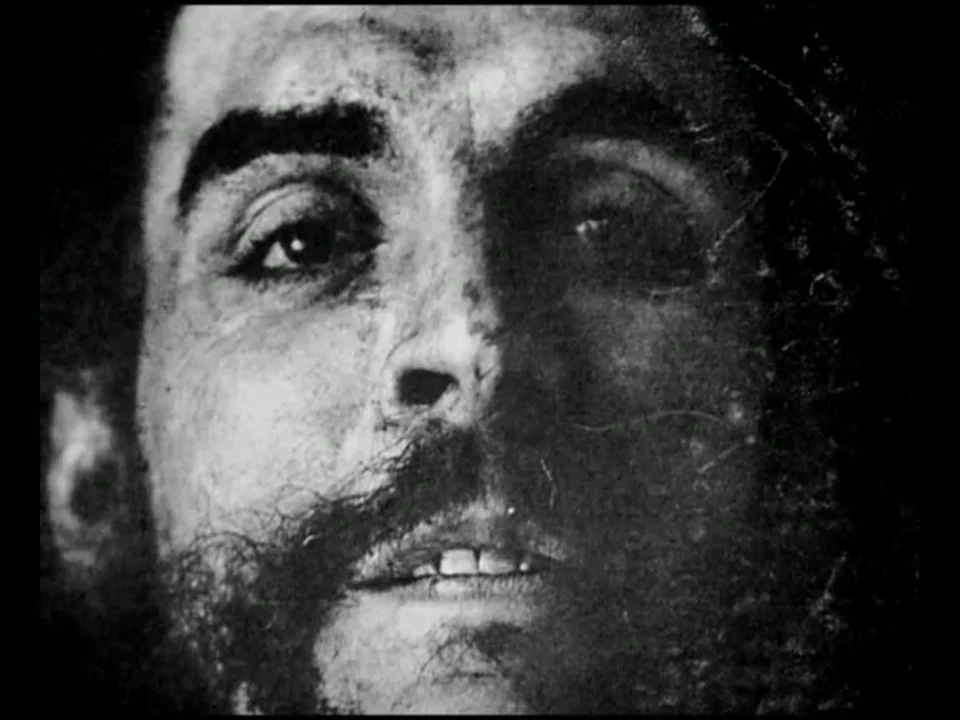 第1分段 01:22:30 / Part 1 01:22:30
The photograph is held for several minutes, turning projection from argument into a direct demand on the audience.
The same death photograph continues to fill the screen; eyes, wounds, and facial texture are not quickly displaced by another montage item.
The extended still is supported only by continuing percussion; no character dialogue supplies the audience's conclusion.
SITE ANALYSISThe prolonged gaze of the death image and percussion turn the absent revolutionary into a direct relation of address, presupposing a revolutionary audience able to respond and continue the action.
Bilibili at 第1分段 01:22:30 / Part 1 01:22:30 Open original still ↗The extended final image of Che Guevara in part 1 was frame-checked.Complete Bilibili carrier; the shot at 第1分段 01:22:30 was checked frame by frame, and the still and timestamp come from the same public upload.
Bilibili · The Hour of the Furnaces, part 1 · verified 2026-08-14In Black God, White Devil, myth, trance, and changing allegiance expose the people's absence. Figures move among religious leader, bandit, peasant, and myth; the collective is not completed before the film begins, and absence becomes a condition of creation.[1, pp. 222–223]
The montage, intertitles, pauses, and discussions of The Hour of the Furnaces directly address a revolutionary audience. This essay uses it as an atlas comparison: it begins with public address, while Perrault and Rouch film a collective speaking position taking form through speech.
FACT → RELATION → TEST
Minor cinema: making a collective voice inside a major language
Minor cinema is not a label for an author's identity or a small production; it is a formal operation that pushes singular experience toward collective enunciation. Stutter, borrowed names, translation, and displacement create new addressee positions inside a major language.The query “我是黑人 让鲁什 1958” was run once (general ranking, all time, page 1) and returned neither Moi, un noir nor a verifiable key excerpt. Chronicle of a Summer and videos about Jean Rouch are different works and were not substituted.
page or search record checked 2026-08-1401:30:00Bandit, mythical figure, and speaker are compressed into one face while allegiance remains in motion through speech.
Corisco's coin-hung hat, facial streaks, and frontal close-up bind costume, body, and mythical identity.
Manuel enters only from the lower edge, so their positions are not stabilized by balanced shot/reverse-shot.
Corisco challenges Manuel in loud, rhythmic speech closer to public performance than private conversation.
SITE ANALYSISFigures change allegiance among peasant, believer, bandit, and myth; the collective is not pre-completed, and Corisco's performative speech turns that absence into a condition of creation.
Cinema 2, chapter 8, pp. 222–223.Bilibili at 01:30:00 Open original still ↗The verbal challenge between Corisco and Manuel was frame-checked.Complete Bilibili carrier; the shot at 单片 01:30:00 was checked frame by frame, and the still and timestamp come from the same public upload.
Bilibili · Black God, White Devil complete film · verified 2026-08-14Chapter 8 of Cinema 2 frames political cinema through a people not yet formed rather than speaking for a completed community. Minor cinema must therefore handle linguistic pressure and the absence of a people at once: it creates deviation within a major grammar and changes both speaker and addressee.[1, Chapter 8, pp. 215–224]
Rodowick's account of minor cinema places fabulation, mixed language, and intercessor relations on one political chain. Borrowed names and postsynchronized voices in Moi, un noir make private life collectively audible; myth and song in Black God, White Devil keep belonging in revision; Police, Adjective exposes through translation, definition, and bureaucratic classification how language controls who may speak. None of the three can be established by the filmmaker's identity or subject label alone.[5, ‘Series and Fabulation: Minor Cinema,’ pp. 139–169]
Film comparisons
Pour la suite du monde
Memory enters plan and labourStorytelling, financing, setting posts, and delegation form a traceable speech-act chain.
Deleuze discusses this film directly here · ch. 6, p. 150; ch. 8, pp. 221, 22301:40:00The group delegates one member to speak for them inside an institutional setting.
Three men converse in an outdoor area of the aquarium; one occupies the position between the other two.
The exchange explicitly delegates one participant to speak for the group.
SITE ANALYSISDelegation is spoken by group members and changes who can speak in what capacity.
Bilibili at 01:40:00 Open original still ↗Official NFB English-version stream; anchor 01:40:00 verified. The displayed window locates that anchor; narrative boundaries await shot-level review.Official NFB full film; the 01:40:00 anchor is verified and the displayed window locates it.
Bilibili · 牛仔C麦 · user-provided public repost page · verified 2026-08-13Moi, un noir
Characters become through voiceAssumed names, postsynchronized voices, and urban experience produce new subject positions.
Deleuze discusses this film directly here · pp. 151, 223The query “我是黑人 让鲁什 1958” was run once (general ranking, all time, page 1) and returned neither Moi, un noir nor a verifiable key excerpt. Chronicle of a Summer and videos about Jean Rouch are different works and were not substituted.
page or search record checked 2026-08-14Black God, White Devil
The missing people as creative conditionMyth, trance, and changing allegiance keep the collective unfinished.
Deleuze discusses this film directly here · pp. 222–22301:30:00Bandit, mythical figure, and speaker are compressed into one face while allegiance remains in motion through speech.
Corisco's coin-hung hat, facial streaks, and frontal close-up bind costume, body, and mythical identity.
Manuel enters only from the lower edge, so their positions are not stabilized by balanced shot/reverse-shot.
Corisco challenges Manuel in loud, rhythmic speech closer to public performance than private conversation.
SITE ANALYSISFigures change allegiance among peasant, believer, bandit, and myth; the collective is not pre-completed, and Corisco's performative speech turns that absence into a condition of creation.
Cinema 2, chapter 8, pp. 222–223.Bilibili at 01:30:00 Open original still ↗The verbal challenge between Corisco and Manuel was frame-checked.Complete Bilibili carrier; the shot at 单片 01:30:00 was checked frame by frame, and the still and timestamp come from the same public upload.
Bilibili · Black God, White Devil complete film · verified 2026-08-14The Hour of the Furnaces
A presupposed revolutionary addresseeBegins from an addressable people, contrasting with a speaking position generated inside the film.
第1分段 01:22:30 / Part 1 01:22:30The photograph is held for several minutes, turning projection from argument into a direct demand on the audience.
The same death photograph continues to fill the screen; eyes, wounds, and facial texture are not quickly displaced by another montage item.
The extended still is supported only by continuing percussion; no character dialogue supplies the audience's conclusion.
SITE ANALYSISThe prolonged gaze of the death image and percussion turn the absent revolutionary into a direct relation of address, presupposing a revolutionary audience able to respond and continue the action.
Bilibili at 第1分段 01:22:30 / Part 1 01:22:30 Open original still ↗The extended final image of Che Guevara in part 1 was frame-checked.Complete Bilibili carrier; the shot at 第1分段 01:22:30 was checked frame by frame, and the still and timestamp come from the same public upload.
Bilibili · The Hour of the Furnaces, part 1 · verified 2026-08-14Put the claim back into more films
These films are not a list of examples but pressure tests: when the same concept meets different spaces, bodies, sounds, and narrations, which relations still hold and which must be withdrawn?
Who says ‘we’, and how does that we appear?
Return fabulation to speech, labour, dispute, and projection: a collective is not an identity present in advance but a traceable result of speech changing relations.
Pour la suite du monde
Collective storytelling turns memory into an actionable ‘we’
The beluga hunt, interrupted for years, is spoken back through elders' bodily memory and then enters tide rules, budgets, posts, labour, and delegation. Story is not a backdrop to action; it organizes an unrealized plan into a present a community can bear.
01:40:00- CONCEPT MOVE
- Speech changes the positions of speaker, addressee, and material arrangement; a people gains a voice in formation.
- SHOT EVIDENCE
- Replay preparation, financing, post-setting, capture, and delegation in order; record when speech changes roles and subsequent action.
- BOUNDARY
- Nostalgic narration only proves that memory exists; fabulation must produce material consequences and new speaking positions in later images.
Cinema 2, ch. 6, p. 150; ch. 8, pp. 221, 223
LOCATORTen site scene records, including the aquarium delegation
Moi, un noir
Borrowed names and post-recorded voices turn lived experience into minor speech
Participants borrow names from film characters, while post-recorded voices reorganize filmed life. Fiction does not erase reality; it lets people speak experience from another position, beginning collective enunciation through personal transformation.
- CONCEPT MOVE
- Participants and filmmakers become other together, giving an individual voice plural directions.
- SHOT EVIDENCE
- Compare street action, borrowed names, post-recorded narration, and bodily attitudes; find when fiction changes the speaker's position toward labour, city, and self.
- BOUNDARY
- Performance or narration alone is not fabulation; they must change who can speak, who is heard, and what speech does.
Cinema 2, ch. 6, p. 151; ch. 8, p. 223
LOCATORBorrowed names, post-recorded voices, and street performance
How scholarship advances the problem
Ronald Bogue
Deleuze on CinemaConnects powers of the false, Rouch's ethnofictions, and modern political cinema.
Used to distinguish character storytelling from external representation.Open full citation ↓Ronald Bogue
Fabulation, Narration and the People to ComeProvides a focused account of fabulation, narration, and the people to come.
Used to construct the full chain from double becoming to collective enunciation.Open full citation ↓D. N. Rodowick
Gilles Deleuze's Time MachinePlaces minor cinema within fabulation, mixed language, and the political structure of a missing people.
Used to distinguish identity labels from formal criteria of language and collective relation.Open full citation ↓References
- 01
DELEUZE PRIMARY TEXT Gilles Deleuze, Cinema 2: The Time-Image, trans. Hugh Tomlinson and Robert Galeta (University of Minnesota Press, 1989).
Chapter 6, pp. 150–155; chapter 8, pp. 215–224Publisher record and purchase access - 02
DELEUZE PRIMARY TEXT Gilles Deleuze, Cinema and Thought seminar, Lecture 12, 5 February 1985, Purdue archive.
Around 114:00, fabulation and the peopleOpen audio, French transcript, and English translation - 03
SCHOLARSHIP Ronald Bogue, Deleuze on Cinema (Routledge, 2003).
Chapter 5, especially “Powers of the False” and “Rouch's Ethnofictions,” pp. 135–164Publisher record and preview - 04
SCHOLARSHIP Ronald Bogue, “Fabulation, Narration and the People to Come,” in Deleuze and Philosophy (Edinburgh University Press, 2006), pp. 202–226.
pp. 202–226DOI and publisher chapter access · DOI 10.1515/9780748627196-016 - 05
SCHOLARSHIP D. N. Rodowick, Gilles Deleuze's Time Machine (Duke University Press, 1997).
‘Series and Fabulation: Minor Cinema,’ pp. 139–169Publisher record and chapter locator